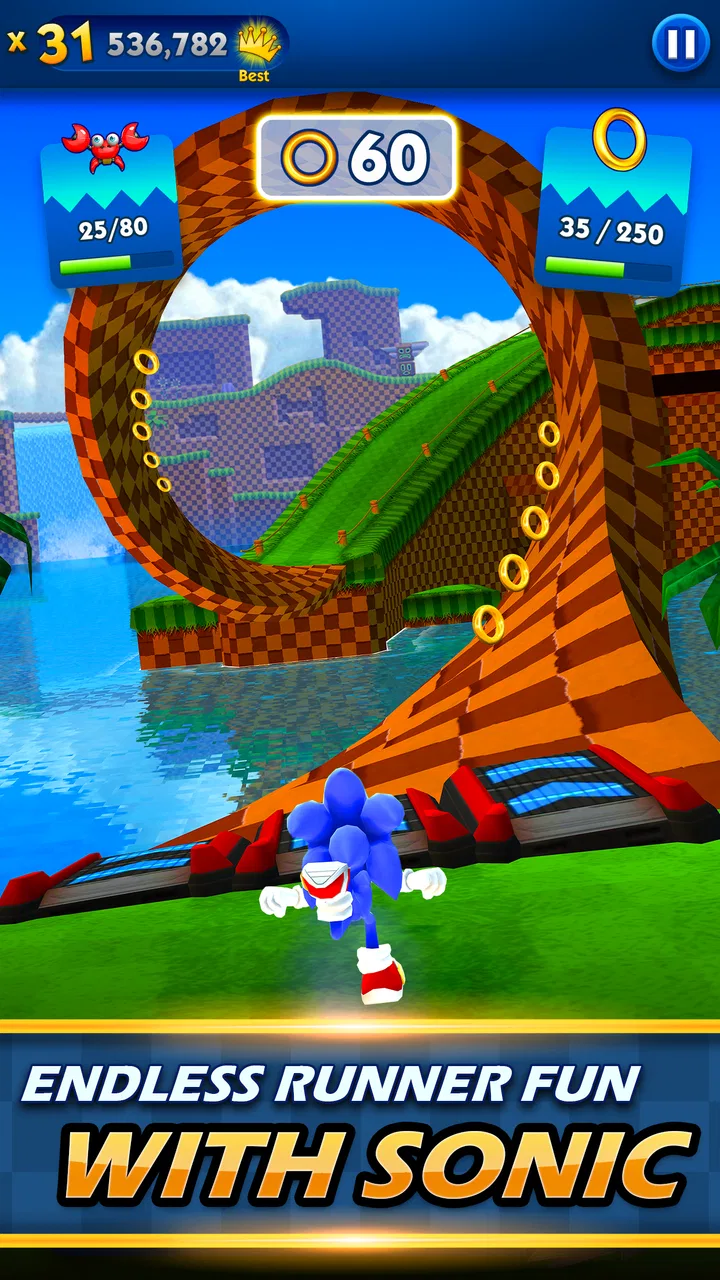
Sonic Dash Run
- 4.7
- Rating
- 500.00M
- Installs
- Free
- Price

 Analysis by App-foxy
Some endless runners are enjoyable for a few minutes and then disappear from my phone. Sonic Dash has lasted longer for me because its basic loop is immediately readable: run forward, react quickly, collect what is in reach, and try to turn a short attempt into a better one. It is a free arcade game from SEGA, built around the familiar Sonic character and a pace that feels much more active than a simple high-score chase.
I approached it as the kind of game I could play while waiting for a bus or taking a short break, rather than as a deep console-style adventure. That distinction matters. The appeal is not a long story or complicated controls. It is the steady pressure of making one more decision correctly while the track keeps moving. When the run ends, I usually know exactly why: I mistimed a move, focused on a reward instead of an obstacle, or became too comfortable with the rhythm.
The game is free to download and suitable for Everyone, although optional purchases range from $0.99 to $99.99 per item. It has been available since Nov 26, 2013, and its current version is 9.4.0. Those details help explain its role: this is an established mobile runner designed for quick repeat sessions, not a one-time premium game that expects you to finish a fixed campaign.
You May Also Like

 AccuWeather: Weather Radar
AccuWeather Review: A Quick, Clear Forecast for Everyday Decisions
For everyday plans, the best forecast is the one you can understand quickly. AccuWeather makes rain timing, radar, and local conditions easy to act on, with a few trade-offs.

 Hill Climb Racing
Why Hill Climb Racing Still Turns Crashes Into One More Run
A tiny car, a bumpy hill and one more upgrade: Hill Climb Racing keeps resurfacing because its simple chaos makes every near-miss feel personal.

 AliExpress - Shopping App
AliExpress Makes Global Shopping Feel Personal, but Shoppers Bear the Risk
AliExpress turns a global marketplace into a pocket-sized discovery engine. Its reach is useful, its shopping loop compelling, and its trade-offs easy to miss.

 Lords Mobile: Kingdom Wars
Lords Mobile Is a Kingdom-Building Routine, Not a Quick Match
A case-by-case verdict on the building, battles, device demands, and social commitments that make Lords Mobile rewarding for some players and exhausting for others.

 PDF Scanner app - TapScanner
TapScanner Makes Paperwork Easier to Capture, Check, and Share
TapScanner makes scanning with a phone feel less like a rescue operation and more like a dependable step in getting work done. Its capture tools are useful, though not flawless.

 Block Blast!
 Shows How Much a Puzzle Game Can Leave Out
A quiet grid game shows why puzzle players increasingly value instant clarity, repeatable skill and low-pressure play—and where the genre still needs to catch up.
More From Our News Desk
View All News


How the first runs create clear goals
The strongest part of the opening experience is how quickly the objective becomes understandable. I do not need to study a long tutorial before enjoying a run. The immediate goal is survival, but the more interesting goal is learning to survive while also taking useful paths. That creates a small decision every few seconds: play safely, reach for a line of collectibles, or risk a tighter route for a better result.
That choice gives the first sessions more shape than simply moving left and right until something goes wrong. I began by concentrating on obstacles, then gradually paid more attention to route planning. The game encourages that shift naturally. A beginner can focus on reacting, while a more experienced player starts asking whether a particular lane change is worth making.
The Sonic theme also helps the early minutes feel energetic rather than anonymous. The sense of speed is important, but I found that the best runs were not the ones where I acted recklessly. They came from keeping my eyes a little ahead of the character and treating the track as a sequence of small problems. That is a useful lesson for new players: do not chase every visible reward. A safe line often produces a longer and more satisfying attempt than a greedy one.
My practical advice is to spend the first few runs learning the visual language of the track. Notice how obstacles appear, how much time you have to react, and which movements feel comfortable on your device. Trying to optimize immediately makes the game feel harsher than it needs to be. The early goal should be consistency, not a spectacular score.
Progress that feels visible during ordinary play
Endless runners need a reason to restart after failure, and this one gets much of that motivation from visible improvement. Even when a run ends quickly, I can usually identify a small gain: I reached a section that previously stopped me, handled a transition more calmly, or collected more before making a mistake. Those modest improvements are what make the repeated structure work.
I also like that progress is not limited to a single personal record. The act of learning the route and refining reactions gives each attempt a purpose. A player who dislikes chasing numbers may still enjoy the process of becoming more reliable. For me, the most satisfying sessions were not necessarily the longest ones; they were the sessions where I corrected one specific mistake and then managed to avoid it.
This is where the game suits short breaks particularly well. If I have only a few minutes, I can start a run without committing to a long chapter or waiting for a large download of new content. If I have more time, repeated attempts provide a natural rhythm: play, notice the error, adjust, and try again. The structure is simple, but it respects the way mobile games are often used.
There is a trade-off, though. Players who need a strong narrative, a map to explore, or a clearly defined ending may find these progress signals too light. The satisfaction comes from improvement and repetition, not from uncovering a conventional adventure. I would recommend it to someone who enjoys mastering a loop, but not to someone looking for a story-led Sonic experience.
Why the difficulty works best when I stop rushing
The challenge is closely tied to attention. At first, the game can feel forgiving because the controls and objective are easy to grasp. The difficulty becomes more meaningful when speed, obstacles, and reward choices begin competing for attention. I found that the curve rewards calm observation more than frantic input. The faster I tried to force decisions, the more often I made a needless mistake.
That makes the game accessible without making it mindless. A new player can understand what to do, but longer runs demand better timing and anticipation. The challenge does not come from learning a complicated control scheme. It comes from maintaining focus while the situation changes. In practical terms, this means the game can be easy to pick up but difficult to play cleanly for an extended session.
One useful habit is to keep a mental priority order. I put immediate hazards first, then choose a safe route, and only after that consider whether a collectible or bonus is worth the extra movement. This sounds obvious, but it changes the feel of the game. Instead of reacting to every attractive object, I make decisions based on survival. That approach helped me extend runs without needing to play more aggressively.
Another tip is to treat failure as information rather than as a reason to restart mindlessly. If I hit an obstacle after changing lanes too late, I try to remember the timing instead of blaming the speed. If I lose concentration after a successful sequence, I recognize that confidence itself became a problem. Endless runners often punish autopilot, and this one is no exception.
The difficulty may not suit everyone. Players who want a relaxed game with little chance of failure could find the repeated interruptions frustrating. Conversely, highly competitive players may eventually want more variety or a deeper mastery system than an endless runner normally provides. Its sweet spot is someone who enjoys quick reactions and incremental improvement, especially when the goal is to beat a previous personal performance.
What keeps me returning, and where the pressure becomes noticeable
The retention design is easy to understand: a run is short enough to repeat, improvement is always close enough to imagine, and failure usually feels recoverable. I often finish an attempt thinking that the next one could go better because the mistake was specific rather than mysterious. That feeling is the engine behind the game’s replay value.
There is also a mild psychological pull in the way rewards and survival compete. Collecting everything may look attractive, but the most disciplined play often means leaving something behind. That tension gives the track more meaning than a straight obstacle course. I am not merely asking whether I can move; I am deciding how much risk I am willing to accept for a better run.
Still, the free-to-play structure deserves attention before installing. Optional purchases are present, and the listed range reaches from $0.99 to $99.99 per item. I can enjoy the core running loop without paying, but players who are sensitive to in-game purchase prompts should approach the game with a clear personal limit. I recommend disabling or protecting purchases on a child’s device, even though the content rating is Everyone.
This is also a game where repetition can expose its limitations. If I play for a long stretch, the same fundamental actions begin to feel familiar. The quick-session design is a strength when I want a break, but it can become a weakness when I expect constant novelty. I would rather play several focused attempts than leave it running for an extended marathon.
Compared with slower arcade games, this offers more immediate pressure and less time to plan. Compared with puzzle games, it gives me less control over the pace but more excitement from real-time reactions. Compared with other endless runners, its biggest advantage is the Sonic identity combined with a clean, accessible loop; its weakness is that anyone who does not enjoy repeated runs may see the structure as narrow.
Everyday situations where it fits naturally
I found three situations where it works especially well. The first is a short waiting period: I can play one or two attempts, stop without losing the thread of a story, and return later. The second is a low-energy break after work or study, when I want something active enough to hold my attention but not something that requires planning. The third is a personal practice session, where I focus on one improvement, such as safer lane choices or better timing around obstacles.
It can also work as a shared casual game for a family member who already recognizes Sonic. The controls are easier to explain than the systems in a role-playing game, and the Everyone rating makes the content broadly approachable. I would still explain the optional purchases before handing over the device, because age suitability and spending suitability are not the same thing.
On the other hand, I would skip it if my main requirement were offline narrative progression, strategic depth, or a relaxing pace. I would also choose a different type of game if I wanted a fixed set of levels that I could complete permanently. The endless format is the point here, not a limitation to overlook.
Device expectations and practical setup
The game supports devices running Android 6.0 or later. Before installing, I would check that the phone meets that requirement and has enough comfortable screen space for quick movements. A smaller or older device may still meet the operating-system requirement, but the experience depends heavily on responsive input and clear visibility. For a fast runner, a crowded screen or unreliable touch response can make fair mistakes feel unfair.
I also recommend playing with a stable grip rather than holding the phone loosely in one hand while walking. The controls may look simple, but small accidental movements matter once the pace rises. If I am using it during a commute, I wait until I am seated or safely stationary. That is both more comfortable and better for concentration.
SEGA’s long-running association with Sonic gives the presentation a recognizable personality, but the game remains focused on action rather than on explaining its world. That is good for quick access and less useful for players who want extensive context. The current version, 9.4.0, is the version I would look for when checking compatibility before downloading.
My verdict on goals, pacing, and long-term appeal
After spending time with it, I see Sonic Dash as a strong example of a focused mobile arcade game. Its early goals are clear, its progress is easy to feel through better runs, and its difficulty rewards attention instead of complicated preparation. The pacing is brisk enough to create excitement, yet the short-session structure makes it practical for ordinary phone use.
The main question is whether the endless format matches my habits. If I enjoy repeating a challenge and improving through small corrections, the game gives me a convincing reason to return. If I need a campaign, rich exploration, or a calm experience without purchase pressure, I would look elsewhere. The game cannot solve that preference mismatch with its Sonic branding.
Its broad reach is reflected in a 4.7 average from around 6.5 million ratings, alongside over 100 million installs. Those figures suggest a very established audience, but they do not replace personal fit. I would not recommend it simply because it is popular; I recommend it because its loop is easy to start, satisfying to refine, and honest about what it is.
For me, the best way to play is to set a small objective before each session: survive a little longer, make fewer rushed moves, or choose safety over tempting rewards. That keeps the repetition purposeful. The real strength is not endless speed by itself, but the steady conversion of mistakes into better timing. If that sounds enjoyable, this free arcade runner is worth trying. If it sounds repetitive rather than motivating, Sonic Dash is probably not the right choice, and a level-based or story-driven game would serve you better.
FAQs for Sonic Dash Run
01What devices are compatible with Sonic Dash: Endless Run?
Sonic Dash: Endless Run is available on both Android and iOS platforms. It requires Android version 4.1 and up, or iOS 9.0 or later. The game is compatible with most smartphones and tablets, ensuring a wide range of device support. Before downloading, check your device’s compatibility in the app store.
02Is Sonic Dash: Endless Run free to play?
Yes, Sonic Dash: Endless Run is free to download and play. However, it features in-app purchases that can enhance the gameplay experience. Players can buy items such as power-ups and character upgrades. These purchases are optional, and the game can be fully enjoyed without spending money.
03What is the main objective of Sonic Dash: Endless Run?
The main objective of Sonic Dash: Endless Run is to run as far as possible, collecting rings and avoiding obstacles along the way. Players can control Sonic and other characters, each with unique abilities. The game also includes missions and challenges to complete for rewards, adding depth to the endless running experience.
04How can I unlock additional characters in the game?
In Sonic Dash: Endless Run, additional characters can be unlocked by collecting character tokens during runs or by purchasing them with red star rings, which are earned through gameplay or available via in-app purchases. Each character has unique abilities, enhancing the strategic element of the game.
05Does Sonic Dash: Endless Run require an internet connection?
Sonic Dash: Endless Run does not require a constant internet connection to play. However, an internet connection is needed for certain features, such as downloading updates, accessing leaderboards, and making in-app purchases. For the best experience, a stable connection is recommended.
Pros
- Fast-paced gameplay keeps you engaged
- Vibrant graphics and smooth animations
- Frequent updates with new features
- Simple controls suitable for all ages
- Offline mode available for on-the-go play
Cons
- Repetitive levels may become monotonous
- In-app purchases can be quite costly
- Occasional ads disrupt game flow
- Limited character customization options
- Some devices experience performance lags

Sonic Dash Run
Gallery